From Conceptual Framework to Classroom Practice
Shifts in ESL Pedagogy
To understand the context surrounding the new devis, it is helpful to situate them within broader developments in second language pedagogy since the mid-1990s, when the previous devis were first developed. Over time, the field has seen growing interest in perspectives that place greater emphasis on meaningful communication, learner agency, integrated language use, and competency development in context.
The shifts outlined below are not intended to suggest that earlier approaches no longer have value, nor that all classrooms should adopt the same practices. Rather, they reflect some of the evolving conversations, priorities, and perspectives that have influenced contemporary language education and informed many aspects of the new devis.
A shift from communicative to task-based to action-oriented perspectives
Communicative Language Teaching (CLT) represented an important move away from structural approaches by emphasizing meaning, interaction, and the ability to communicate in the target language. In many classrooms, however, communication often remained centered on simulated exchanges or classroom-based activities.
Task-based language teaching (TBLT) emerged as one response to this challenge by organizing learning around tasks that require learners to use language to accomplish meaningful goals. This perspective encouraged greater integration of skills and a stronger focus on purposeful communication.
The action-oriented approach builds on elements of both traditions while placing greater emphasis on learners as social actors who use language to participate in authentic or realistic social practices. From this perspective, tasks are often connected to audiences, purposes, contexts, and concrete outcomes that encourage learners to mobilize linguistic, strategic, and social resources in meaningful ways.
A shift from content coverage and isolated skills to competency-based, integrated language use
Earlier approaches to language teaching often emphasized the systematic teaching of grammar, vocabulary, and thematic content, sometimes through activities organized around separate skills such as reading, writing, listening, and speaking. While these practices continue to play an important role in many classrooms, educators and researchers increasingly explored ways of helping learners use language more holistically and purposefully.
Competency-based perspectives place greater emphasis on what learners are able to do with language in context and recognize that communication often involves the integration of multiple skills and resources. This perspective encourages the design of learning experiences in which language is used for meaningful action rather than practiced only in isolated forms.
A shift from monolingual, transmission-based communication to intercultural, plurilingual, and mediated communication
Earlier models of language teaching often approached communication primarily as the transmission of information within a single linguistic and cultural framework. More recent perspectives, including those associated with the Common European Framework of Reference (CEFR), place greater emphasis on communication as a social, cultural, and multilingual process.
This has contributed to growing interest in intercultural communicative competence, plurilingual competence, and mediation. These perspectives recognize that learners may draw on multiple linguistic and cultural resources when interpreting meaning, interacting with others, and helping facilitate understanding across contexts. Together, they encourage a broader understanding of communication as a collaborative and adaptive process.
A shift from evaluation as measurement to evaluation as professional judgment based on performance over time
Traditional approaches to evaluation often focused heavily on discrete language elements such as grammar accuracy or vocabulary knowledge, frequently assessed through isolated tests or short performances. While these approaches can provide useful information, many educators began exploring evaluation practices that more fully capture learners’ ability to use language meaningfully in context.
This contributed to increased interest in competency-based evaluation, performance tasks, multiple sources of evidence, and evaluation over time. Within these perspectives, evaluation is viewed less as the measurement of isolated knowledge and more as a process of professional judgment informed by observable performances and clearly defined criteria.
A shift from teacher-directed, classroom-bound learning to self-regulated learning in a networked environment
Traditional models of education often positioned the teacher as the primary source of knowledge and the classroom as the central site of learning. Today, however, learners have increasing access to authentic language through digital and networked environments that extend far beyond the classroom itself.
Streaming platforms, social media, online communities, digital publications, and interactive technologies now provide learners with continuous opportunities to encounter and use language in meaningful contexts. Access to input, interaction, and feedback is no longer limited to classroom time or traditional instructional materials.
As a result, many educators have placed greater emphasis on helping students develop the ability to navigate these environments strategically and independently. In this context, learner autonomy and self-regulation become increasingly important dimensions of language development, while the teacher’s role may increasingly involve guiding, supporting, and structuring meaningful learning experiences within a broader ecosystem of language use.
The new devis reflect many of these broader conversations and perspectives within the field. For some teachers and departments, adapting to the new devis may therefore involve reconsidering how learning scenarios are structured, how tasks are designed, and how students engage with language in meaningful contexts over time.
Teaching Framework and Guides
To support this shift, a series of complementary guides has been developed to offer possible pathways for implementing the new ESL devis. Rather than prescribing a single method or model, these guides present research-informed perspectives and practical tools that teachers and departments may adapt according to their own contexts, students, and professional expertise.
The new devis are intentionally flexible and approach-agnostic. As such, these resources are not intended to define “the” way to teach, but to support reflection, experimentation, and pedagogical coherence across a variety of teaching practices. Together, they highlight connections between competencies, meaningful tasks, learning activities, and evaluation in ways that may help teachers design learning experiences aligned with the spirit of the devis.
Together, these resources provide a conceptual foundation for the examples and practices presented throughout this section, while recognizing that teachers remain the experts best positioned to adapt these ideas to their own educational realities.
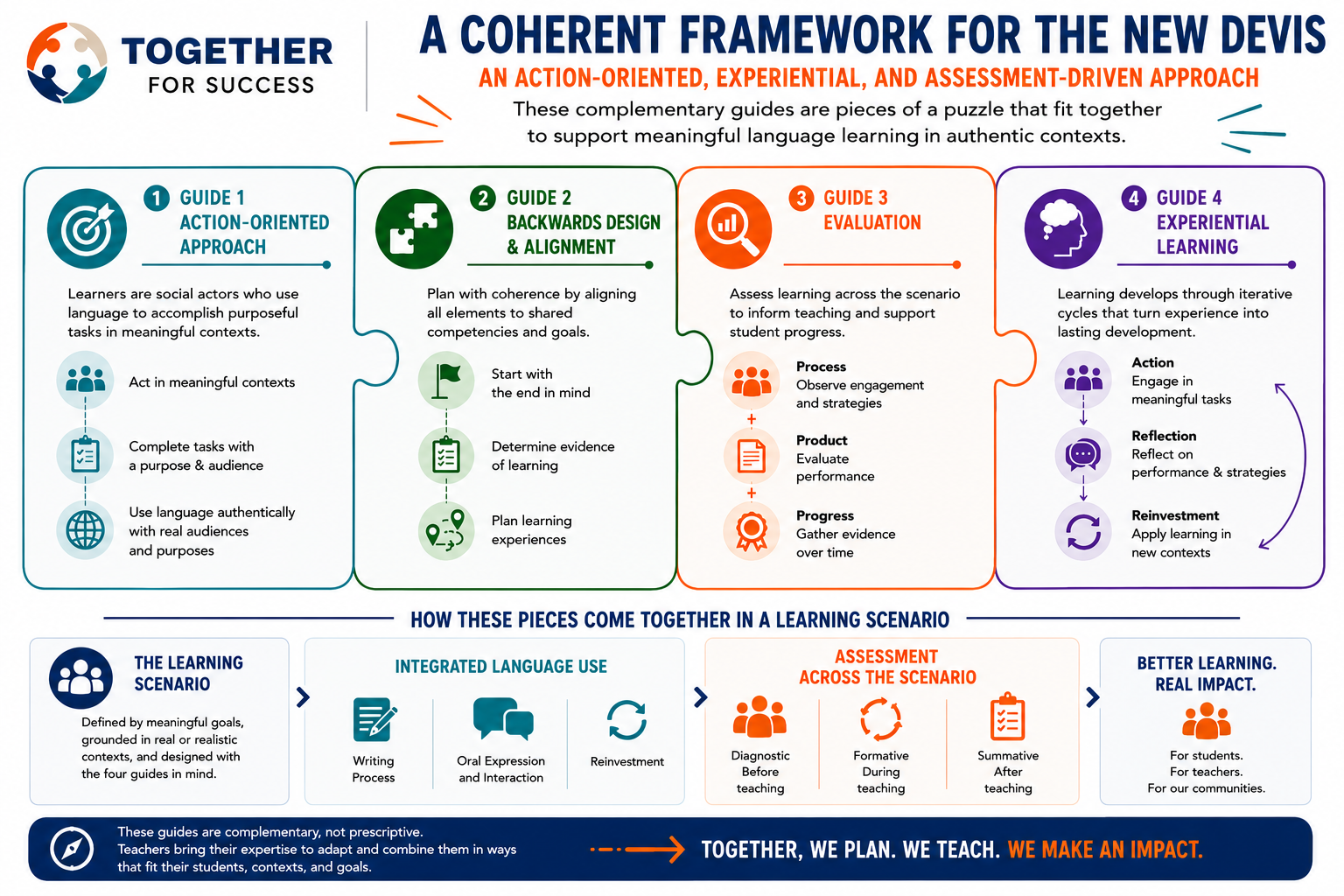
Infographic Summary Infographic: A Coherent Framework for the New Devis
These complementary guides are pieces of a puzzle that fit together to support meaningful language learning in authentic contexts.
Summary Infographic: A Coherent Framework for the New Devis
The principles of experiential learning are further illustrated through complementary media resources.
Coming soon Video Video: Experiential Learning
This capsule demonstrates how experiential learning can transform second language classrooms by engaging students in meaningful, action-based tasks. Rather than focusing on passive acquisition, students use the language to communicate, collaborate, and solve real or simulated problems, moving through cycles of experiencing, reflecting, conceptualizing, and reinvesting.
New Possibilities
For many years, language instruction in CEGEPs placed a strong emphasis on academic discourse, particularly formal essay writing. While this remains an important skill, it represents only one dimension of language use, and one that is often addressed in other disciplines.
The new devis create space for a broader range of communicative practices. By emphasizing adaptation to context, purpose, and audience, they allow teachers to incorporate a wider variety of genres and modes of expression, including creative, professional, and everyday forms of communication. This shift reflects a more accurate understanding of language as a social practice.

Coming soon Video Fr Video: Ludique
This resource shows how interactive and playful activities can be integrated into coherent learning sequences. When aligned with a meaningful final task, such activities contribute directly to the development of language, strategies, and confidence, rather than functioning as isolated moments of engagement.